
Low Water Pressure Through an Entire Commercial Floor? Where to Look
October 22, 2026
QUICK ANSWER: When every fixture on one floor runs weak but the floors above and below are fine, the problem is almost never the fixtures themselves. The cause sits in whatever feeds that floor as a group: a partly closed or failing valve on the riser branch, a pressure regulator that has drifted out of adjustment, a section of pipe narrowed by scale, or a booster system that no longer keeps up. Checking pressure at several points, starting at the service entrance and working toward the affected floor, shows which one it is before anyone cuts into a wall.
Your tenant on the third floor calls for the second time this week. Every sink in the suite runs at a trickle, the break room faucet takes a full minute to fill a pot, and the restroom flush valves barely clear. You send someone to check the second floor and the fourth floor, and both are fine. Only the third floor is struggling, and it is struggling everywhere at once.
That pattern is useful information. A single weak faucet points to a clogged aerator or a worn cartridge. A whole floor going weak together points to something upstream that all of those fixtures share. In a Greater Boston building with decades of pipe additions, tenant buildouts, and equipment swaps layered on top of each other, there are only a handful of places that shared cause tends to hide.
Why One Floor Behaves Differently From the Rest
Water reaches each floor of a commercial building through a branch that comes off a vertical riser. Every branch has its own valves, its own pipe size, and sometimes its own regulator. When pressure drops across an entire floor, the question is what that branch has that its neighbors do not, or what has changed on it recently.
Gravity matters too. Pressure falls as water climbs, so the highest floors always have the least to spare. A building that has operated fine for years can start showing problems on its upper floors when the incoming supply dips during peak demand, or when a booster pump slowly loses output. That is why the first thing worth establishing is whether the trouble is limited to one floor or gets steadily worse as you go up.
Start With the Valves Nobody Remembers Touching
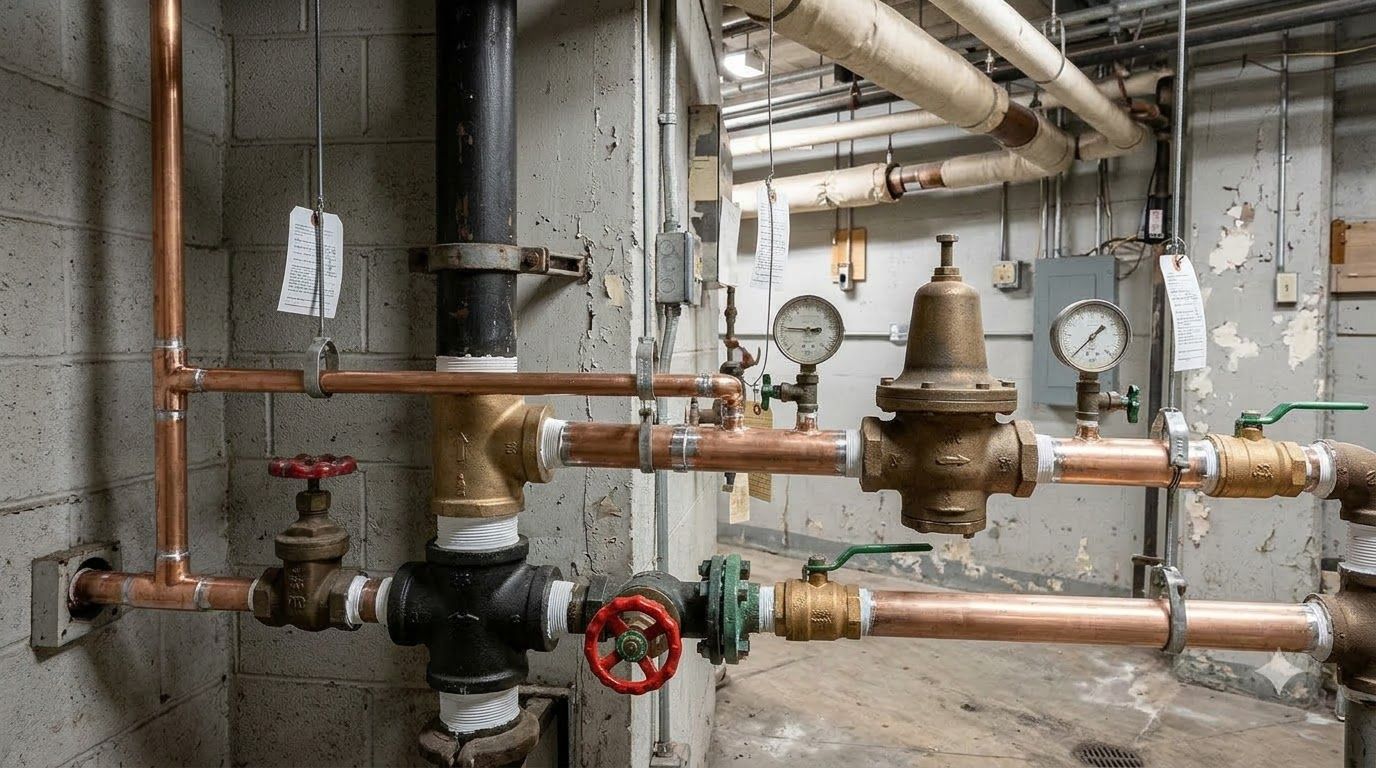
The most common finding on a floor wide pressure complaint is a valve that is not fully open. Isolation valves on a riser branch get closed during renovations, tenant buildouts, and repairs, and they are not always reopened all the way afterward. A gate valve left a quarter turn short of fully open will not leak and will not make noise. It just quietly limits the flow to everything downstream.
Older gate valves have a second failure mode. The internal disc can separate from the stem, so the handle appears fully open while the disc sits partly across the opening. Only a technician who tests flow and pressure on both sides of the valve will catch that.
A good walk through starts at the branch serving the affected floor. Every shutoff along the way gets confirmed, and any that feel loose, stiff, or inconsistent get flagged for closer inspection or replacement.
Pressure Regulators That Have Drifted
Many commercial buildings use pressure reducing valves to keep the lower floors from seeing more pressure than their piping and fixtures are meant to handle. Those regulators contain springs and diaphragms that wear with age. When one drifts, the downstream pressure it delivers can slide well below where it was originally set.
If a regulator serves only a zone or a single floor, a drift like this produces exactly the symptom you are describing: weak pressure everywhere on that floor and normal pressure elsewhere. Commercial buildings generally run somewhere between forty and eighty pounds per square inch, depending on height and design, so a floor reading far below the range its neighbors hold is a strong hint.
Regulators can also fail because grit from the supply side lodges in the seat. A technician will read pressure before and after the valve. If the incoming side is healthy and the outgoing side is low, the regulator is the answer, and it can usually be rebuilt or replaced without disturbing the rest of the system.
TIP: Ask your maintenance staff to write down the pressure reading at a hose bib or gauge port on each floor at the same time of day, once in the morning and once at midday. A floor that is low only during peak hours points toward supply or booster capacity. A floor that is low all day points toward a restriction or a regulator on that branch.
Scale, Rust, and Narrowed Pipe
Older steel and galvanized piping corrodes from the inside. Mineral scale and rust build up along the walls, and over many years the opening that water travels through shrinks. The pipe looks perfectly healthy from the outside. Because the narrowing happens gradually, the floor never has a single day when it breaks. It simply gets a little weaker every year until tenants start complaining.
Branches that carry hot water are especially prone to this, since heat speeds up scale formation. If the weak pressure shows up on both the hot and cold side, the restriction is probably on a shared section. If it shows up mostly on the hot side, look at the water heater connections, the recirculation loop, and any strainers or check valves along it.
Camera inspections and flow testing can show how much of the original opening is left without opening up finished ceilings. When a section is badly narrowed, cleaning or replacing just that section restores the floor without touching the rest of the building.
Strainers, Check Valves, and Backflow Devices
Commercial systems are full of components that are supposed to stay out of the way until needed. Strainers catch debris before it reaches sensitive equipment. Check valves keep water moving one direction. Backflow preventers protect the public supply from anything that might flow backward.
Every one of those parts can clog or stick. A strainer packed with sediment after a water main flush can cut flow dramatically. A check valve with a worn flapper can hang partly closed. A backflow assembly that has not been serviced in years can develop its own pressure loss, since the design itself drops pressure as water passes through.
If the pressure problem began right after a hydrant flush, a street repair, or utility work nearby, debris reaching these components is a very likely culprit.
When the Booster System Is the Real Story
Taller buildings and those with long pipe runs often rely on a booster pump or a pressurized tank to lift water to the upper floors. These systems are designed to switch on, hold a target pressure, and shut off smoothly. When they wear, the symptom tends to show up first on the highest floors and during busy periods.
Common issues include a pump that has lost output from worn internal parts, a pressure tank that has lost its air charge, and a control sensor that is reading incorrectly. An air charge problem can make a booster cycle on and off rapidly, which tenants experience as pressure that surges and fades. It is worth watching the pump while someone runs fixtures on the affected floor. If it is not starting, running constantly, or hunting back and forth, the booster deserves attention.
One caution applies here. Adding a larger pump to cover for a restricted pipe wastes energy and puts extra strain on joints and fittings that were already tired. The booster should only be upgraded after the rest of the system has been confirmed healthy.
A Sensible Order for Tracking It Down
A technician working a floor wide pressure complaint follows a deliberate sequence, because each step narrows the field.
First, confirm the pressure at the service entrance. If the supply coming into the building is low, nothing inside can fix that. Second, read pressure at a point just before the affected branch. Third, read it again at the far end of the floor. The gap between those readings shows how much is being lost between them. Fourth, check every valve, strainer, and regulator along that path. Fifth, only if everything above checks out, look at pipe condition and sizing.
This order matters because supply problems and internal problems can exist at the same time, and fixing one without noticing the other leaves tenants unhappy. It also keeps a building from spending effort on the wrong repair.
WARNING: Low pressure on any floor can also reduce flow to fire protection connections and fixtures that depend on steady supply. If your sprinkler gauges or any fire protection equipment shows readings below normal, treat that as urgent and have it inspected right away rather than waiting for a routine visit.
What to Gather Before Calling Anyone
You can shorten the diagnosis by collecting a few facts first. Note which floors are affected and whether the problem is hot water, cold water, or both. Write down when it started and whether anything changed around that time, such as tenant work, a street repair, or a water heater service. Record whether the pressure changes with the time of day. And if your building has gauges at the riser or the booster, photograph them.
For a property manager with multiple tenants, one more detail helps: whether the complaint is limited to one suite or spans the whole floor. Sorting that out takes a short walk and saves a service call from going down the wrong path.
Frequently Asked Questions
Why is the water pressure low on only one floor of my building?
A single floor losing pressure points to something serving that floor alone, such as a partly closed branch valve, a drifted regulator, or narrowed pipe. A whole building problem would point to supply or booster.
Could a closed valve really cause this without any leaks or noise?
Yes. A valve only partly open limits flow silently. It often happens after renovations when a shutoff is not fully reopened, or when an older valve fails internally while the handle still looks open.
How do I know if the problem is the pressure regulator?
A technician reads pressure on both sides of the regulator. If the incoming side is healthy and the outgoing side is low, it is likely drifting or fouled. Regulators can usually be rebuilt or replaced.
Does low pressure on one floor mean I need a booster pump?
Not necessarily. A booster helps only when the system is sound and the supply cannot reach the floor. If a restriction or faulty valve is the cause, a booster treats the wrong problem and strains piping.
Why does the pressure get worse at certain times of day?
When many people use water at once, demand rises and pressure drops, especially on upper floors. Weak only at peak times points to supply or booster capacity, while weak all day points to a branch restriction.
Can old pipes alone cause a whole floor to lose pressure?
They can. Scale and rust slowly narrow steel and galvanized pipe from the inside, shrinking the opening each year. Flow testing and camera inspection show how much pipe remains open before any walls are touched.
Trace The Branch Before The Next Call
A whole floor of weak water is a puzzle with a small number of answers: the valve nobody reopened, the regulator that drifted, the pipe that narrowed over decades, the strainer full of debris, or the booster that no longer keeps pace. The fixtures are rarely the problem, because a floor failing together shares a cause upstream. Working through the possibilities in order, with pressure readings at each point, replaces guesswork with a clear answer and keeps the repair aimed at what is actually wrong.
Farfaras and Son Plumbing and Heating CO INC
has spent 65
years tracing pressure problems through commercial buildings across Billerica, MA, where decades of pipe additions and tenant buildouts layer on top of each other. Reading the branch valves, the regulator on both sides, and the booster performance in sequence is what separates a focused repair from a month of opened ceilings. Finding the restriction before cold weather and peak demand stack onto it keeps one weak floor from becoming a string of tenant calls.