
Smell Gas Near the Rooftop Unit or Meter? The Safe First Steps
September 30, 2026
QUICK ANSWER: If you or anyone else catches a gas odor near a rooftop HVAC unit or the meter bank, leave the roof immediately and get everyone nearby to do the same, without touching any switch, phone, or piece of equipment along the way. From a safe distance, call your gas utility's emergency line, 911, or both, and stay away until they tell you it's clear. Don't go back up to search for the source, shut anything off, or "just take a quick look." The smell itself is the signal to act, not a detail to investigate first, and a licensed technician needs to clear the area before anyone resumes normal roof access or restarts the equipment.
Your building engineer climbs up to the roof on a cold January morning to see why the rooftop unit serving the second floor won't hold temperature, and before he's even reached the RTU, he catches that faint rotten-egg smell drifting off the meter bank near the parapet. It's not strong. It comes and goes with the wind. He almost talks himself out of it being anything.
That instinct to second-guess a faint smell is exactly the wrong one on a commercial roof. Meters and rooftop units sit in one of the harshest spots on any Greater Boston property, exposed to wind, ice, sun, and repeated freeze-thaw cycles that stress fittings and connectors far more than anything tucked into a basement mechanical room ever sees. A whiff that seems too weak to matter can still mean gas is escaping somewhere along that run.
Property managers are usually the first ones to catch this smell, whether during a fall walk-through before heating season starts or while responding to a tenant's complaint about a unit that won't cool or heat properly. What happens in the next few minutes matters more than figuring out where the leak is. That part belongs to the utility and a licensed technician, not to whoever happens to be standing on the roof when the smell hits.
Why the Roof Is a Common Place to Catch a Gas Smell
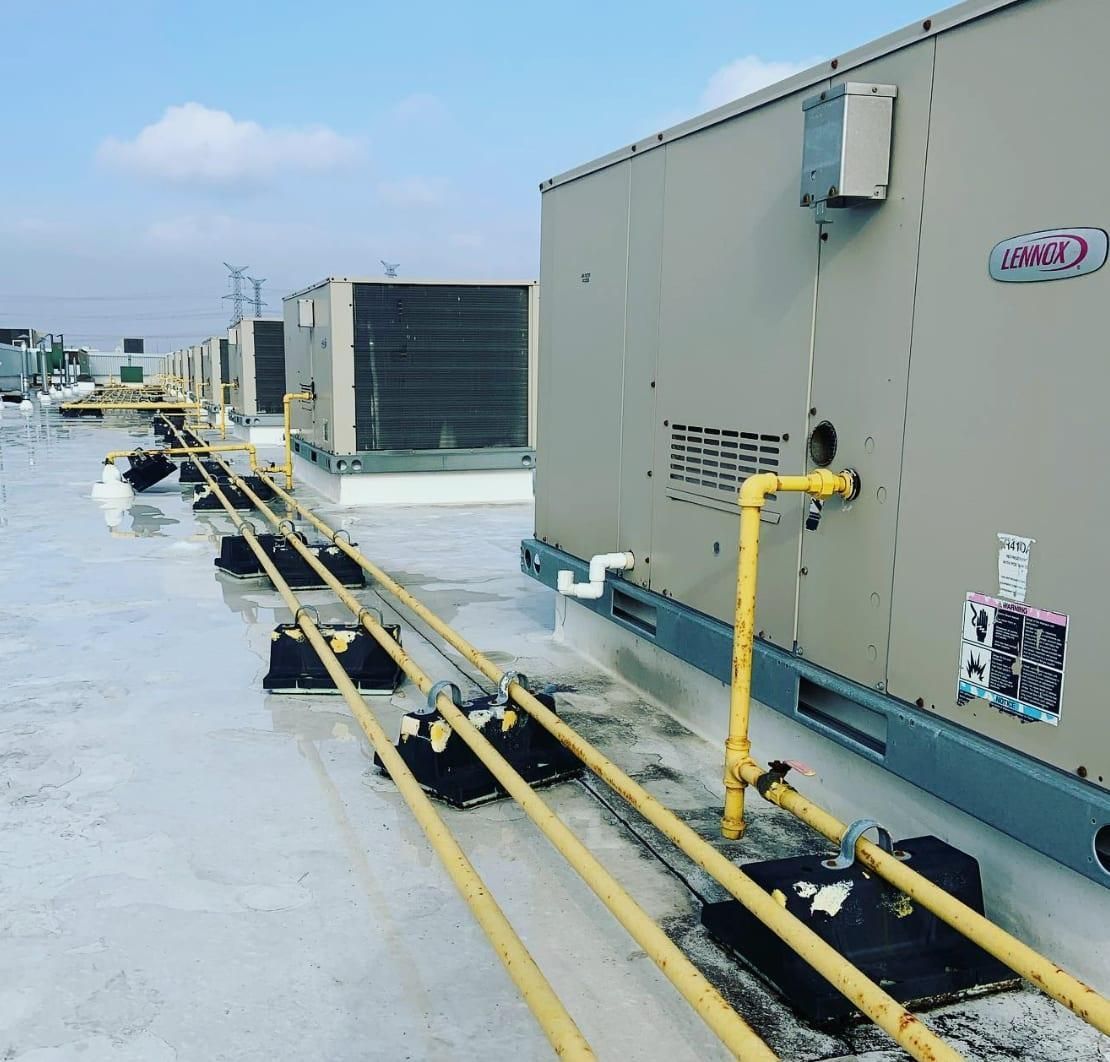
Rooftop units and the meter sets that feed them sit at the end of a long, exposed run of gas piping, and that run includes more joints, unions, and flexible connectors than most people picture. Gas travels from the meter, up through a riser or along the building exterior, across the roof deck, and into the RTU's gas valve, with a shutoff and union fitting at nearly every transition point. Each of those connections is a place where a seal can degrade.
New England weather is hard on all of it. A meter bar and rooftop piping run can sit at ten below zero on a February morning and climb past ninety degrees on a black rubber roof membrane in July, and that swing happens dozens of times a season, not once. Metal fittings expand and contract with every cycle, gaskets stiffen and crack in the cold, and flexible connectors that were rated for the job when installed can lose flexibility years before anyone thinks to check them. Add wind-driven ice, ponding water around the meter base, and the vibration of a compressor cycling on and off a few feet away, and you've got a setup where a slow leak can develop without any single dramatic cause.
None of that means every rooftop gas smell traces back to old equipment. Storm damage, a contractor bumping a line during roofing or antenna work, or even animals chewing at an exposed connector can all open a leak on equipment that's otherwise in good shape. The cause matters for the repair. It doesn't matter at all for what you do in the first sixty seconds.
The First Few Minutes: What to Do the Moment You Smell Gas
Speed matters here, but not the kind of speed that sends someone running around trying to fix things. The goal is to get people away from the source and get the right call made, fast.
Get out, and get others out too. If you're on the roof, head straight for the exit. If you manage the building, get anyone in the mechanical penthouse, on a roof deck, or working near a rooftop access hatch moving toward the stairs. Don't stop to grab equipment or finish a task.
WARNING: Don't touch anything that could spark. Light switches, thermostats, phones, radios, garage door openers, even a key fob button, can all provide enough of a spark to ignite gas that's built up to a combustible concentration. Leave switches exactly as you found them, on or off, and don't plug in or unplug anything on your way out. If you're already holding a phone, keep walking and call once you're a safe distance away, not while you're still near the source.
Once everyone is clear, move to a safe distance from the building, not just the roof, before making any calls. Then call your gas utility's emergency line, 911, or both, and tell the dispatcher exactly where the smell was coming from, the roof, the meter bank, the RTU. Don't go back up to check on the smell, shut off the unit, or look for the leak yourself while you wait. That part of the job belongs to people trained to enter a suspected leak area safely, with the right detection equipment and the right protective steps already in place.
Why a Faint Smell Deserves a Full Response
Here's the part that trips people up: natural gas has no smell of its own. Utilities add an odorant, a sulfur-based compound related to the ones that make skunk spray and rotten eggs so unmistakable, specifically so a leak announces itself long before it reaches a dangerous concentration. That odorant is detectable by most people at levels measured in parts per billion, which sits nowhere close to the concentration needed for gas to ignite.
That gap is the whole point. A faint, intermittent whiff on a windy roof isn't a sign the leak is minor. It's often just what a real leak smells like from thirty feet away with air moving across it. Wind can carry the odor away as fast as it appears, thin it out, or push it toward one corner of the roof and away from another, so the strength of the smell tells you almost nothing about how much gas is actually escaping down at the connection. Treat a faint smell with the same urgency as a strong one, because from a detection standpoint, that's exactly what it is.
Gas utilities in Massachusetts treat any reported odor as an emergency worth an immediate response, not just the strong or obvious cases. That standard exists because odorant behaves unpredictably outdoors, and because the alternative, waiting to see if the smell gets worse, removes the margin of warning the odorant was added to provide in the first place.
Who to Call, and What They Actually Do
Once you've reported the smell and everyone is at a safe distance, two different responses typically follow. The utility dispatches a crew to check for gas in the area and confirm whether it's safe to be near the building. A licensed gas piping professional handles the part that comes after that: finding exactly where the leak is and fixing it.
That diagnostic work on a rooftop looks different than it does indoors. A technician will typically walk the entire exposed run with a combustible gas detector, checking every union, shutoff valve, and flexible connector between the meter and the RTU's gas valve rather than assuming the leak is at the most obvious-looking fitting. Soap-solution testing at suspect joints confirms exactly where gas is escaping once the detector narrows the search. After the repair, the line gets pressure tested before gas service is restored to the unit, not just visually inspected, because a fitting that looks fine can still be letting gas past a worn seal.
TIP: If you're the one who first noticed the smell, jot down a few details while you wait for help to arrive: roughly what time you first caught it, whether it was constant or came and went, and which direction the wind was blowing. That kind of detail sounds minor, but it can point a technician toward the windward side of the meter bank or a specific section of rooftop piping faster than starting the search cold.
Common Culprits on a Commercial Roof
A handful of causes show up again and again on rooftop gas connections across older Greater Boston commercial buildings, and knowing them doesn't change what you do in the moment, but it does help you understand what a technician is likely looking for.
Flexible connectors at the RTU gas valve take the brunt of it. They're designed to absorb vibration from the unit's compressor and fan, but years of that same vibration, combined with UV exposure and temperature swings, can crack the material or work a fitting loose at the connection point. Meter bar fittings face a different kind of wear: runoff from melting snow and ice, sometimes carrying road salt tracked up during roof access, accelerates corrosion at threaded joints faster than most people expect from a component that's rated for outdoor use.
Physical disturbance accounts for a fair number of leaks that have nothing to do with age. A roofing crew setting down equipment, a satellite or antenna installation, or even birds and squirrels nesting near a warm rooftop unit can knock a connector loose or damage a line that was in perfectly good shape the week before. And on buildings where the RTU sits close to the roof edge or a parapet, ice damming in winter can put pressure directly on piping that was never meant to bear that kind of load.
After the Repair: Getting Back to Normal Operations
Once a technician confirms the leak is fixed and the line has passed a pressure test, gas service to the unit gets restored and the RTU can be restarted. Ask for a plain-language summary of what was found and repaired, including which fitting or section of pipe was the source. That record is worth keeping in the building's maintenance file, both for your own reference and for whoever handles the next seasonal inspection.
It's also worth using the incident as a reason to look at the whole rooftop gas run, not just the spot that failed. A connector that cracked from age or UV exposure often has neighbors on the same run that are wearing out on a similar timeline, especially on older equipment that's been through a decade or more of Massachusetts winters. Catching the next one during a scheduled inspection beats catching it because someone smelled gas again next February.
Frequently Asked Questions
Is it normal to smell a little gas near a rooftop unit sometimes?
No. Natural gas has no odor of its own, so any smell means the added odorant is present and gas is escaping somewhere. Treat every instance the same: leave, reach a safe distance, and call.
Can wind make a gas leak on the roof harder to detect?
Yes, and it cuts both ways. Wind can carry a strong smell away or push a faint one toward you from a much larger leak, so smell strength should never guide how seriously you respond.
Should I shut off the rooftop unit myself if I smell gas?
No. Operating any switch, control, or valve near a suspected leak, including the unit's own controls, risks a spark that ignites accumulated gas. Leave everything as it is and let the responding crew handle shutoff.
How long does it typically take to find a leak on a commercial rooftop?
It depends on how many connection points sit along the run, but a technician with a combustible gas detector usually narrows it to one fitting within an hour or two. Larger buildings take longer to clear.
What if the smell is gone by the time help arrives?
Report it anyway, and don't assume it resolved itself. Odor thins with wind or temperature shifts while gas still escapes, and a technician can often locate the leak with detection equipment even after the smell fades.
What a Rooftop Gas Smell Really Tells You
A gas odor near a rooftop unit or meter isn't a puzzle to work out while you're standing next to it. The smell has already given you the answer, and the response stays the same every time: get clear of the roof, keep everyone else clear, and make the call from a safe distance. Whoever traces the leak comes later, with detection tools and training the moment doesn't allow for. The roof will still be there once the area is cleared and safe again.
That same wear tends to show up across a whole rooftop run rather than at a single fitting, since the connections aging next to the one that failed have weathered the same decades of Massachusetts freeze-thaw. Farfaras and Son Plumbing and Heating CO INC, based in Billerica, MA, has spent 65
years tracing these leaks on commercial roofs, and that history is a reminder that a smell caught early is far easier to resolve than one caught late.